
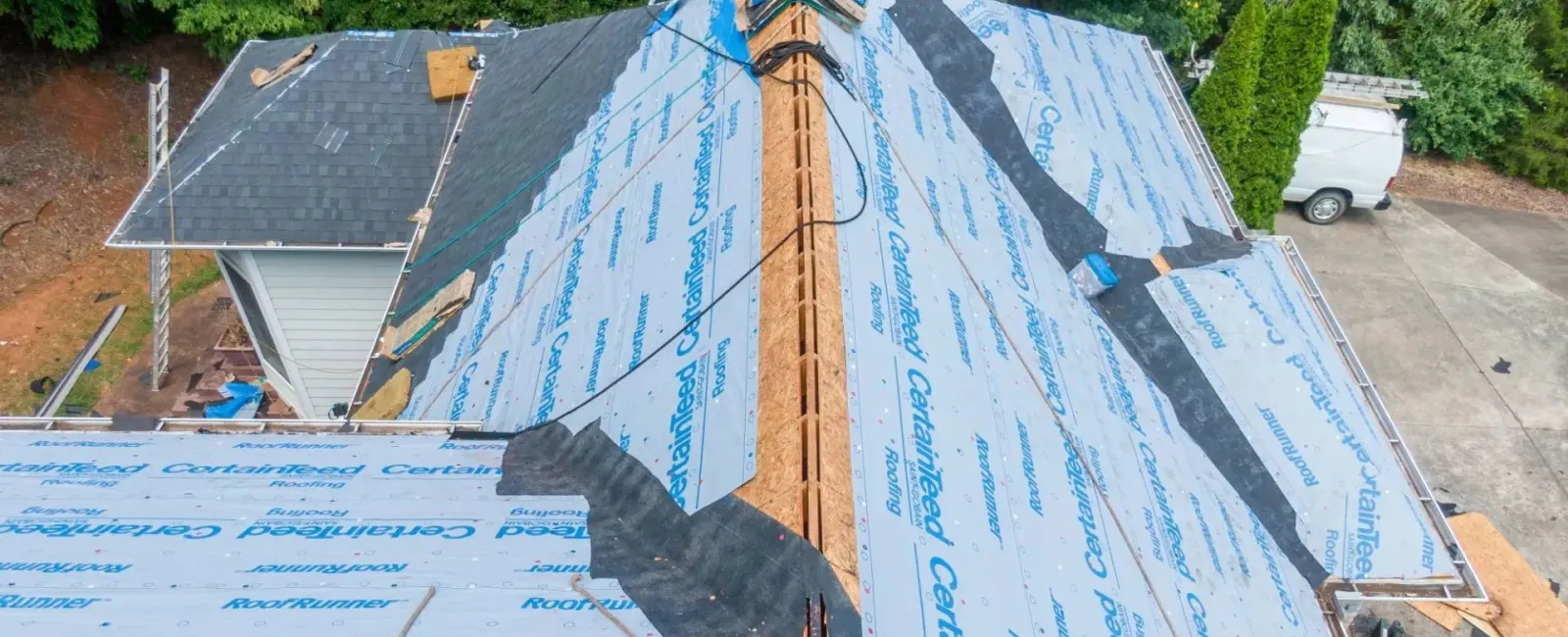
Roofing underlayment is a water-resistant barrier installed directly on your roof deck beneath shingles that provides critical secondary protection against moisture infiltration, wind-driven rain, and ice dams. This protective layer prevents water from reaching your roof deck when shingles fail or lift, safeguards your home during installation before shingles are applied, and meets building code requirements that mandate underlayment for valid roof warranties. Without proper underlayment, even premium shingles cannot protect your home from moisture damage that leads to rot, mold growth, and structural deterioration.
Understanding the role of underlayment in your roofing system helps you make informed decisions during roof replacement that affect your home's protection for decades. The right underlayment choice depends on your climate, roof slope, shingle type, and budget, with options ranging from traditional felt to advanced synthetic membranes offering superior performance. Professional installation ensures this critical barrier functions as designed, creating a watertight seal that extends roof life and prevents costly water damage repairs.
Understanding the Critical Role of Roof Underlayment
Roof underlayment serves as your home's last defense against water penetration when shingles become compromised by age, storm damage, or installation defects. While shingles provide visible weather protection, underlayment creates an essential backup barrier that catches water before it soaks into roof decking and causes extensive damage. This secondary protection becomes especially critical during severe weather events when wind-driven rain can force water under shingle edges or when ice dams form along roof edges during winter.
The underlayment layer also protects your roof deck during the installation process, which often takes several days to complete depending on roof size and complexity. Rain can occur unexpectedly during installation, and exposed roof decking without underlayment would absorb moisture immediately, warping boards and creating conditions for mold growth before your new roof is even finished. Professional installers apply underlayment in sections as they work, ensuring your home stays protected throughout the entire replacement process.
Building codes across North America require underlayment installation on all residential roofs, recognizing this layer as fundamental to proper roof performance rather than optional. Insurance companies increasingly scrutinize roofing systems after storm damage claims, with missing or improperly installed underlayment potentially voiding coverage for water damage. Manufacturers of premium shingles explicitly require underlayment as a condition of their warranties, understanding that even the best shingles cannot perform optimally without proper secondary protection beneath them.
Comparing Underlayment Types and Performance Characteristics
Traditional felt underlayment, made from organic mat saturated with asphalt, has served the roofing industry for over a century but comes with significant limitations that modern alternatives address more effectively. Available in fifteen-pound and thirty-pound weights, felt tears easily during installation, absorbs water when exposed to rain, and wrinkles when wet, creating uneven surfaces that compromise shingle installation quality. Contractors who still use felt typically choose thirty-pound weight for better durability, though even this heavier version struggles with the demands of modern installation schedules that may leave underlayment exposed for days.
Synthetic underlayment revolutionized roof protection over the past fifteen years by addressing every major weakness of traditional felt through engineered polymer construction. These lightweight materials cover more area per roll, reducing the physical burden on installation crews while delivering superior tear resistance that withstands foot traffic during installation. Synthetic underlayment repels water instead of absorbing it, maintains dimensional stability when exposed to weather, and provides slip-resistant surfaces that improve installer safety on steep slopes. The material's strength allows installers to leave it exposed for extended periods without degradation, accommodating construction delays without compromising roof protection.
Self-adhered underlayment represents the premium category with rubberized asphalt backing that bonds directly to roof decking, creating watertight seals that mechanical fasteners cannot match. This sticky-back membrane excels in vulnerable areas where water concentrates including valleys, eaves, skylights, and chimneys, forming continuous barriers that prevent leaks even when water sits on the roof surface. The adhesive backing eliminates fastener penetrations that create potential leak points, while the membrane's flexibility allows it to seal around nail penetrations from shingle installation. Self-adhered products cost significantly more than other options but deliver unmatched protection in high-risk areas where leaks cause the most expensive damage.
Selecting the Right Underlayment for Your Climate and Roof Type
Climate conditions dictate which underlayment provides optimal performance, with cold weather regions requiring different solutions than hot, humid areas or dry climates. Homes in snow country benefit most from self-adhered ice and water barrier installed along eaves where ice dams form, preventing water backup from penetrating roof decking when melting snow refreezes at roof edges. Standard practice involves installing self-adhered membrane extending at least three feet inside the exterior wall line, though homes with chronic ice dam problems need more extensive coverage that protects entire lower roof sections.
Hot climates with intense sun exposure demand underlayment that withstands high temperatures without softening or deteriorating, making synthetic products ideal for southern regions where roof surface temperatures exceed one hundred fifty degrees during summer. Traditional felt becomes brittle and cracks under prolonged UV exposure, while quality synthetic underlayment maintains flexibility and strength for months if installation delays occur. The lighter color of synthetic materials also reflects more heat than dark felt, reducing attic temperatures slightly and improving overall roof system performance in hot weather.
Roof slope significantly influences underlayment requirements, with low-slope roofs demanding more robust water protection than steep pitches where water runs off quickly. Building codes require enhanced underlayment on roofs with slopes below four-in-twelve, often mandating two layers of felt or self-adhered membranes across the entire roof surface rather than just vulnerable areas. Steep roofs shed water efficiently but still need proper underlayment along valleys and penetrations where water concentrates during heavy rain. Metal roofing installations typically require synthetic underlayment rather than felt because metal's slick surface and expansion-contraction cycles can damage traditional felt through abrasion and movement.
Installation Quality Determines Underlayment Effectiveness
Proper underlayment installation requires specific techniques that ensure water sheds downward without penetrating horizontal seams or fastener holes. Professional installers start at the roof's bottom edge, overlapping each course over the previous layer by several inches so water flowing down the roof cannot work its way between seams. Side laps where underlayment sections meet horizontally need adequate overlap secured with cap nails or staples at specified intervals, creating continuous barriers without gaps that allow water infiltration.
Common installation mistakes undermine even premium underlayment performance, with inadequate overlap being the most frequent problem that allows water to reach roof decking. Contractors rushing through installation sometimes skip proper fastening, allowing wind to lift underlayment and create gaps where water enters. Using too many fasteners creates unnecessary penetrations, while too few fasteners allows the material to shift or blow away during storms before shingle installation. Self-adhered products require clean, dry decking surfaces for proper bonding, with installation during wet or cold weather preventing adequate adhesion that compromises waterproofing performance.
Valley areas demand special attention during underlayment installation because these channels concentrate water flow from converging roof planes, creating high-pressure conditions that test waterproofing capabilities. Best practices involve installing self-adhered membrane through valleys extending at least twelve inches on each side, followed by synthetic underlayment over the remaining roof surface. Penetrations like pipes, vents, and chimneys need careful detailing where underlayment wraps around or seals against these objects, with self-adhered products excelling at creating watertight seals around complex shapes.
Understanding Cost Differences and Long-Term Value
Underlayment costs vary dramatically based on material type, with traditional felt being the least expensive option but potentially costing more over time through reduced roof life and increased leak risk. Fifteen-pound felt typically costs less per square foot than any other option, making it attractive for budget-conscious projects, though the labor savings from synthetic products' larger coverage per roll often offset material cost differences. Thirty-pound felt prices approach synthetic underlayment costs while delivering inferior performance, making felt a questionable choice for most modern roofing projects.
Quality synthetic underlayment adds several hundred dollars to typical roof replacement costs compared to felt but provides benefits that justify the investment through improved durability and installation efficiency. A two-thousand-square-foot roof might see an additional three hundred to five hundred dollars in material costs for synthetic versus felt, representing less than five percent of total project cost while dramatically improving water protection. The labor savings from synthetic's lighter weight and better coverage often reduce installation time by several hours, partially offsetting material cost increases through reduced labor expenses.
Self-adhered underlayment represents the premium price tier, costing two to three times more than synthetic for full-roof coverage, making it cost-prohibitive for most projects unless limited to vulnerable areas. Strategic use of self-adhered membrane in valleys, eaves, and around penetrations while using synthetic elsewhere creates optimal protection at manageable cost, combining each product's strengths without budget-breaking expenses. Homes in severe weather climates or with complex roof geometries justify self-adhered underlayment's premium pricing through superior leak prevention that protects valuable interiors and prevents costly water damage repairs.
Recognizing How Underlayment Affects Roof Warranty Coverage
Shingle manufacturers explicitly require proper underlayment installation to validate their product warranties, with failure to use approved underlayment potentially voiding coverage for premature shingle failure. Warranty terms specify acceptable underlayment types and installation methods, with many premium warranties requiring specific synthetic products rather than traditional felt. Homeowners who opt for cheap felt to save money may unknowingly sacrifice warranty protection worth thousands of dollars if shingles fail prematurely from manufacturing defects.
Enhanced warranties from manufacturers often mandate self-adhered underlayment in vulnerable areas as a condition of extended coverage periods that protect against shingle failure for thirty to fifty years. These system warranties covering both shingles and components deliver superior protection but require specific combinations of manufacturer products installed according to detailed specifications. Contractors certified by shingle manufacturers understand these requirements and can guide homeowners toward underlayment choices that maximize warranty benefits rather than undermining coverage through incompatible products.
Documentation proving proper underlayment installation becomes critical when filing warranty claims years after roof installation, with manufacturers requiring installation photos or contractor affidavits confirming approved products were used correctly. Homeowners should request photos during installation showing underlayment type, proper overlap, and correct installation in vulnerable areas, creating evidence that supports future warranty claims. Working with established contractors who maintain detailed installation records protects homeowners when proving proper installation becomes necessary for claim approval.
Identifying Signs of Underlayment Failure
Underlayment deterioration rarely becomes visible from ground level until significant damage occurs, making attic inspections crucial for detecting problems before they cause expensive structural damage. Dark stains on roof decking visible from the attic indicate water penetration through compromised underlayment, with active leaks showing wet spots or dripping during rain. Daylight visible through roof decking suggests severe underlayment and shingle failure requiring immediate attention before moisture ruins insulation and causes ceiling damage in living spaces below.
Exterior signs of potential underlayment failure include lifted or missing shingles that expose the layer beneath, with deteriorated felt appearing dark and brittle while failing synthetic shows tears or detachment. Ice dams recurring at the same roof locations each winter signal inadequate underlayment protection along eaves, with the cycle of freezing and thawing eventually forcing water under shingles and through compromised barriers. Granule loss on shingles accelerates once underlayment fails because moisture trapped between layers prevents proper drainage, creating conditions that deteriorate shingles from underneath while appearing intact from street level.
Water stains on interior ceilings during heavy rain or rapid snow melts indicate active leaks that have progressed beyond underlayment failure into structural damage territory. These visible signs appear only after extensive hidden damage occurs, with affected roof decking potentially requiring replacement rather than simple shingle and underlayment renewal. Proactive attic inspections every few years detect underlayment problems while they remain repairable through targeted fixes rather than complete roof replacements necessitated by ignored small leaks that eventually cause major structural issues.


